The Imaginary Child Loophole
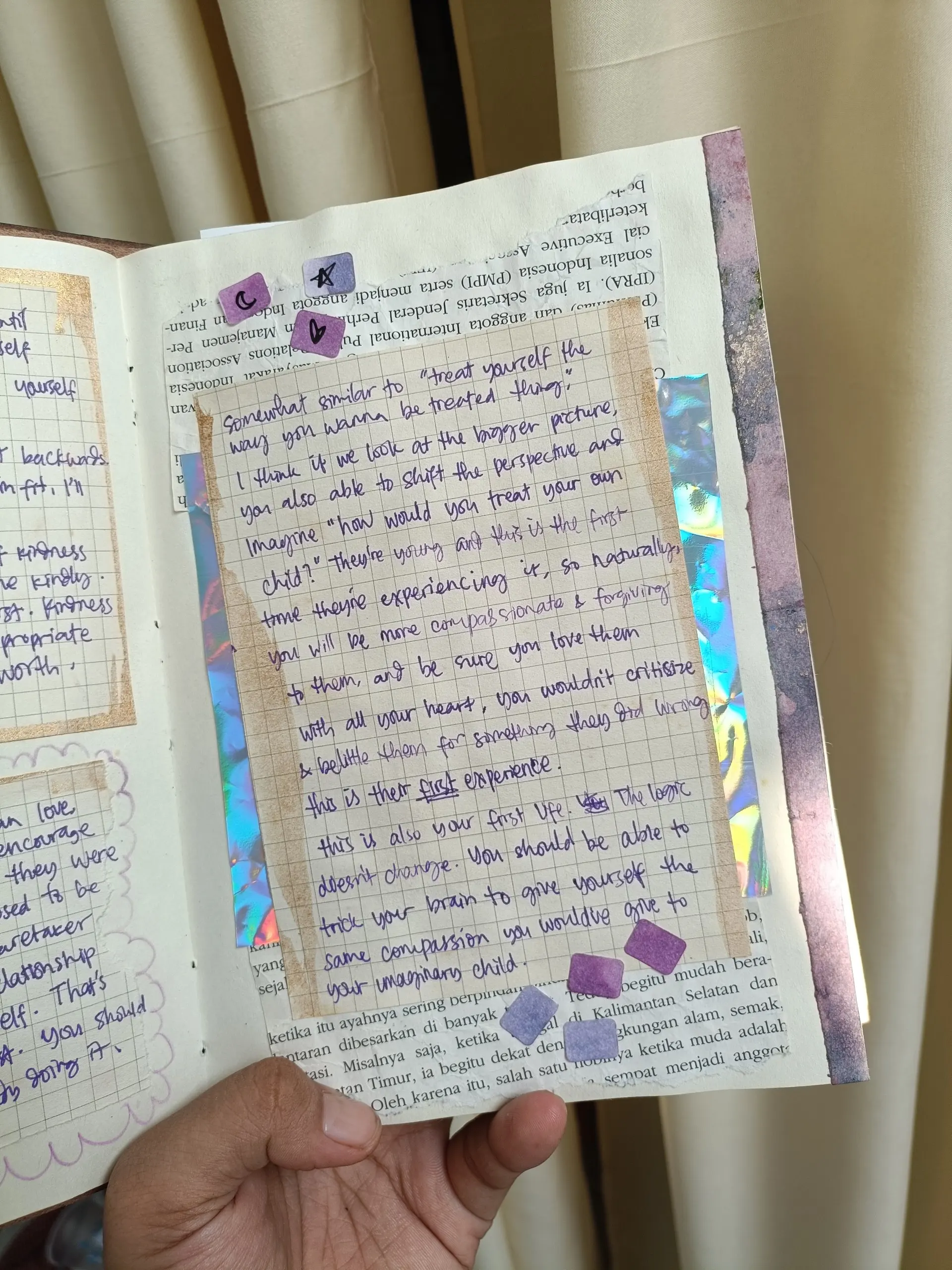
I used this mantra for the longest time “treat yourself the way you want to be treated”, but this time I pushed it further. Instead of imagining how I want to be treated, I birthed an imaginary child. And then I asked myself: how would I treat them?
Naturally, I’d want to be the best mother ever existed in the world. Better than my own mom or any other great moms out there. I would be compassionate. Forgiving. I wouldn’t tear them apart for messing up, because I know they’re new at this. They’re allowed to fumble.
Then came the sentence that actually stopped me: this is also your first life. The logic does not change just because the person struggling happens to be… me.
Your brain doesn’t actually know who’s talking
In an fMRI study, Longe et al. (2010) found that self-critical thinking activated the lateral prefrontal cortex and anterior cingulate regions associated with error monitoring and threat processing, while self-reassuring thinking activated regions linked to compassion and care for others. Basically, these aren’t just two different moods. They seem to involve two genuinely different ways of responding in the brain. When the threat system takes over, our attention becomes much more focused on defending ourselves than actually learning from what happened (Longe et al., 2010). And that’s kind of the opposite of what we need when we’re trying to grow, build a habit, or recover from a mistake. Kristin Neff’s work on self-compassion suggests that self-kindness activates the body’s caregiving system instead, which is associated with feelings of safety, secure attachment, and soothing through the oxytocin-opiate system (Neff, 2023).
So when you mentally “become the parent” comforting your imaginary child, you’re not just being sentimental. You’re basically giving your brain the sense of safety it’s missing in that moment, helping it shift out of threat mode and into a state where it’s more capable of learning, processing, and actually changing.
That’s why shifting your perspective, like I did in my journal entry, can be thought of as a kind of nervous system hack. You’re using imagination to give yourself the regulation that your brain isn’t able to give itself in that moment.
Why This Matters for Habit-Building (Hello, Atomic Habits)
James Clear’s core argument in Atomic Habits is that lasting change isn’t about willpower, it’s about identity. You don’t build a habit by shaming yourself into it; you build it by becoming, bit by bit, the kind of person who does that thing. Every small action is a “vote” for the identity you’re trying to build (Clear, 2018).
Now here’s the connection, shame is a terrible vote-caster. When you talk shit to yourself for messing up, you’re casting a vote for the identity of someone who fails and gets punished for it. which reinforces avoidance, not growth. Self-compassion, on the other hand, keeps you in check. It says: you’re new at this, of course you messed up, of course you forgot, this is your first time doing this version of your life.
In other words, self-compassion isn’t the soft alternative to discipline. In a lot of cases, it might actually be what makes discipline possible in the first place. Breines and Chen (2012) found across four experiments that people who were encouraged to respond to themselves with self-compassion after failing or doing something they regretted were actually more motivated to do better. After getting a bad test result, for example, they were more willing to study, and they were more committed to not making the same mistake again. Meanwhile, self-criticism seems to be much more connected to avoidance and self-handicapping, including things like procrastination (Neff, 2023; Sirois et al., 2019, as cited in Neff, 2023).
Why journalling helps
This is also why I think the fact that this happened through journaling actually matters. It wasn’t just a thought that briefly crossed my mind. I wrote it down.
Putting your thoughts on paper creates a little bit of distance between you and whatever you’re feeling. Instead of being completely inside the emotion, you’re able to step back and actually look at your own thoughts. Expressive writing can help create this kind of self-distance, and that people who wrote about their experiences from a more distanced perspective tended to have better emotional adjustment over time. (Park, Ayduk, and Kross (2016))
I think that’s probably part of why the shift from “how do I want to be treated?” to “how would I treat my own child?” actually worked. It wasn’t just an abstract idea floating around in my head. Writing it down gave me enough space to actually see the difference. Writing forces you to slow down a little, which gives the more reflective part of your brain a chance to catch up with the emotional reaction. And when you’re trying to stop yourself from spiralling into self-criticism, that pause can matter a lot.
How to practice it
You don’t always need to create a whole imaginary-child metaphor every time. The basic idea is pretty simple:
- notice when the self-critical voice starts talking.
- Ask yourself: would I say this to someone I love who’s completely new at this?
- Then give yourself the same response you’d give them.
- If none of those work, you can also try to give those critical voice a name, to separate it from your own head, something like, “Not today jessica, you can shut the hell up now.”
If you keep doing this, then, going by Clear’s framework, you’re not just having one random moment of being nice to yourself. You’re repeatedly reinforcing a different way of seeing yourself: someone who allows themselves to grow through patience instead of trying to improve through punishment.
And I think the last part of the journal entry is probably the most important: this is also your first life. That’s enough reason to give yourself the same patience you’d give anyone else who was starting from zero.
References:
Clear, J. (2018). Atomic habits: An easy & proven way to build good habits & break bad ones. Avery.
Longe, O., Maratos, F. A., Gilbert, P., Evans, G., Volker, F., Rockliff, H., & Rippon, G. (2010). Having a word with yourself: Neural correlates of self-criticism and self-reassurance. NeuroImage, 49(2), 1849–1856. https://www.sciencedirect.com/science/article/abs/pii/S1053811909009987?via%3Dihub
Park, J., Ayduk, Ö., & Kross, E. (2016). Stepping back to move forward: Expressive writing promotes self-distancing. Emotion, 16(3), 349–357. https://doi.org/10.1037/emo0000121